Look what we have!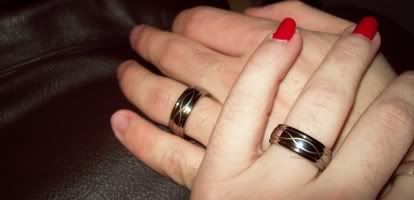
Handfasting hasn't happened yet, and we won't be doing any of the legal end of things for quite some time (changing of names mainly, since we aren't signing a marriage contract as long as the laws are discriminatory), but we have our indestructible engagement rings. Look at them!
Showing posts with label wicca. Show all posts
Showing posts with label wicca. Show all posts
Thursday, February 11, 2010
Shameless Boasting

Thursday, January 21, 2010
Left Behind
A coworker mentioned at one point that she had the keys to the Kingdom, and that's what matters to her. She pointed to the nice Jewish fellow we work with and mentioned that he does as well. Pointedly no comment was made to me.
I said, "Well. My Kingdom's here. I got shit to do."
She replied... that she thought I'd be left behind as a teacher. That I have that light about me.
I know she probably meant this as a compliment (and given how often she compliments my fire and intellect and whatever, it seems likely), but man. I don't go to work to hang out with people whose highest available praise for me is that I'll be left behind after the Rapture.
*sigh* These people. I love my coworkers; I really do. This one woman, though, just drives me up the wall with this shit.
Dear Rapturist Christians: Find better ways of complimenting atheists or Pagans or... y'know. Generally other people who don't share your batshit insane views about when God's gonna beam us all up to the mothership of heavenly bliss, and who's not gonna get to come and what we'll be doing while you spend eternity playing Celestial Golf with Saint Fuckface, patron of Dumbass Zealots.
Sunday, February 22, 2009
Cherry-Picking/Orthodoxy.
A question came up on a forum I frequent.
Is it Wrong to stray from specified guidlines within a path? Will doing so tarnish a given practice? Will doing so show disrespect to those that have "done the work"? Should we adhere to the rules? Conversely, does holding onto the traditions from maybe thousands of years in the past keep us from moving forward? Should we take what we like, what is of use, and discard the rest?
Here's what I think. This is an easier question to answer with religions like Islam that have a core statement of faith. If you believe that there is no god but Allah and Muhammad is his prophet, that's all you have to believe. The other Pillars of Faith are all about action. So whatever else you believe, that one statement is your criterion. As I understand it, if you're on board with that, you're on board with Islam. If not, you're not.
Religions like Hinduism, Wicca, etc. are much trickier. A hard statement of faith like that--while extremely useful from a perspective of creating and sustaining a cultural identity for the group--is difficult precisely because excluding what is "not us" from what is "us" is contrary to what many Pagans want to see happening. Which basically means that developing any kind of coherent cultural identity within the group is contrary to what many Pagans want to see happening.
Christianity is somewhere in the middle. There are certainly statements of faith ("Jesus Christ is the son of the One True God and he died to redeem us from sin" or the like), but because there are so many definitions with their own interest in developing a unique core identity (which means they allow and exclude beliefs or believers based on criteria of their own in order to keep a coherent definition of their group)... there is a lot of fuzziness there. For example, multiple schools of thought about the nature of Christ.
There are the Nestorians, who feel that Jesus the man and Christ the son of God are effectively two different essences, even though they're centered around one guy and one name. Catholics are obviously not down with this (since whether the Virgin Mary was mother to just the human nature of Jesus or whether she birthed the whole kit and caboodle is kind of an important disputing point for them).
What I'm saying with all of this is that there are a lot of Muslims who meet the clearly-defined criteria set out by Islam, and are therefore justifiably defined as Muslim. There are Muslims who fit culturally but may not believe in the Shahadah. Islam has an easier time defining one as Muslim and one not than traditions like the various Pagan groups.
My personal feeling is that traditional groups are including and excluding certain beliefs out of a desire to maintain a cohesive identity. They basically just want to be able to know who they are. This isn't important to some Pagan groups, but out of respect to the ones that do place a priority on it, I wouldn't claim their name unless I fit their definitions. For groups that don't care who claims their name, sometimes I will when I'm intersecting with them.
So for me it's not about needing to define myself "correctly." It's about defining myself in a way that is respectful to the groups I may or may not be a part of depending on how much of a priority they place on being cohesive and how important it is to them to know who they are as a group.
So for me, it's not about an "Old Guard" needing to control their followers. It's about a group controlling their own identity, and if I respect them I'll let them do that for themselves if they need it. I won't take away their power to know who they are by clinging on to the group and muddling things up if the truth is that I'm actually something different from them.
That felt like a long ramble, but I hope I sort of got around to the point in there somewhere.
For other answers to this question, see the thread here.
Monday, February 2, 2009
A rare personal entry!
She's going to change the world...
She's going to change the world...
But she can't change me.
My partner has commented in the past that I have an odd approach to religion, even my own. I view it as a cultural system in which I either want to participate or not. If I gain from it as a person, it's good. If I do not, then I have no use for it and will leave it to the people who can gain.
But what this means is that while I can throw myself into a practice wholeheartedly, throwing myself into the beliefs is somewhat of a trickier proposition. This is simplified by the fact that I don't care about how a religion answers questions of science or fact. I don't care if a holy book says that the world was created in six days or whether an even more ancient oral tradition posits a planet on the back of a turtle (on the back of a turtle on the back of another turtle...). That stuff isn't for religion, and if I make it about answering questions for which we simply have not figured out the facts... well, I'm missing all the stuff it does that matters (and is actually interesting).
Some people reading are aware that I'm a member of a Wiccan circle. We play pretty fast and loose with dogma in my circle, and that was essential to me feeling comfortable there. We draw from many different traditions so that we can attempt to learn or accomplish something new. Thankfully other my circle-mates are also aware of the colonialist implications of picking buffet-style from other religions as well, so there's a lot of respect there and I don't have to smack anyone with various bits of miscellaneous scholarly discourse.
Anyway, that's not the point. The point is that we negotiate lots of different traditions by acknowledging that different things work for different people. The real question here for many folk (Pagans in particular, though anyone in an interfaith social group will face it eventually) is why.
To some people, all gods are real. Some of these believe that we make them real by creating or coalesce those divine power forces using our own personal power of will. Some of these believe that there is simply one massive pool of divine energy that everybody draws from in the way that best fulfills their needs.
To some people, only some gods are real. They have to be "real" gods, preferably ancient. After all, a religion that sprang up two thousand years ago carries a lot more weight than a religion that sprang up five years ago, or six months (even if a religion scholar would see little functional difference aside from age).
To other people, no gods are real. Religion is best experienced through allegory and metaphor, as a meditative practice that allows for access to multiple perspectives, opportunity to answer questions that many individuals just wouldn't think to ask.
I am personally somewhere between a monist (it's all the same, just with different faces on the divine to break It down into smaller, easily-digestible pieces) and an atheist. How the fuck do I manage that? By not fucking caring whether the facts are verifiably true, instead worrying about the processes. Do the processes of the religion do for me what I'm setting them up to do? Yes? Good! I win at religion!
I don't think this necessarily makes me an agnostic. I'm not ambivalent or indecisive, which is what "agnostic" implies to me. I genuinely do not give a damn at this phase in my life whether god is blue or brown or has four arms or two or a beard or exists at all. For many people the idea of a deity watching over or supporting them is helpful, and is a useful avenue for personal growth. Personally, no answer to that question is useful to me.
If scientists proved tomorrow that there is no divine force, deity, whatever, I'd be stunned that they'd figured out a way to test it... but I wouldn't throw out religion. At least not my religion. I don't fucking care if there's a god/dess, and I don't really tend to petition anything outside myself in the way that many magick-users and praying Christians (though there's not actually any difference if you ask a non-Christian). So why do I care whether someone answers?
Same if they proved there was a divine force, I think. Again, what the hell did they do to prove that one, but... meh. I still reserve the right to disagree with or even ignore a deity if I choose. Free will is awesome, and if I'm not letting a deity tell me what to do... does it matter whether they're shouting their divine heads off without me listening? It's still the same world it was yesterday, and my life would still be my own.
It's not indecision. It's unconcern. It makes no nevermind to me one way or the other. I just plain do not care.
I do care whether I am absorbing a code of ethics and customs that I believe to be useful and beneficial in my life. If I find out conclusively tomorrow that there is or isn't a deity out there, the world will still be the same place it was today, and what works will still be the same as it was today.
This means that I can accept and cherish lots and lots of religious traditions without fretting over whether telling beads really wins Catholics brownie points with God, or whether my menstrual cycle is a cosmic metaphor, or whether I'll be born again after I die. I am doing what I need to do to make my life work, and I assume everyone else is as well.
I think that perhaps someday I might make a useful sort of spiritual-leader-type-person, simply because I'm good at making use of what I've got and seeing the good in what we have. I ask decent questions, and think a little ahead. I could be useful to other people who are just looking for a set of customs and perspectives to fit them better than the one to which they were likely born and raised.
But there are problems. I can't just run out and become a priestess. For one, does anyone really want to talk to a priestess who doesn't care whether the divine force we're all here to revere actually exists? For another thing, I don't know what it would do to my relationship with my partner. I've already had to face the possibility that because I practice a religion, he won't be able to commit to having me in his life. If I became a religious leader of some variety... it might be more of a strain than our relationship can take. While I know he would never demand that I give up any aspiration or dream for his sake, I do have to consider what sacrifices I might be making. Whether they'll be worth it in the end.
I'm still looking. I have a better idea of what I am, and I'm taking steps to get a better handle on that. The question of where I am can come later, but I'll have to chew on it eventually. I don't know how that will resolve, but I foresee emerging a new person. I have to trust myself and assume I will come out of it better. I always seem to do that, and damn it I can do it again.
Friday, October 17, 2008
THAT OLD BLACK MAGIC
Y'know, I love reading about people's experiences and observations. I think there's something to be said for finding out what other people see, and in the current political climate it's easy to miss out on opportunities to observe McCain and Palin supporters in "their native environment," surrounded by other supporters without supervision by those dastardly 100% Jesus-Free Marxist Wiccan Jihadists (no, really, watch this video because it's long but gets better and better as it goes) like Obama and his ilk. They can't possibly spending all their time crying for the death of Barack Obama at one of McCain-Palin's regular Two Minutes' Hate rallies.
Turns out that, no, sometimes they have the decency to be self-righteous instead of violent. I guess it's an improvement.
Upon entering Starbucks, I immediately realized that the McCain/Palin folks were having a little meeting. I saw several women in dresses wearing pink buttons proclaiming "Women for McCain/Palin". A few of them brought their husbands who were sporting buttons saying things such as "Sportsman for McCain/Palin" and "NOBama". I sat down at the table next to the group just as they were starting their meeting.
As soon as the last member of their group came in, they prayed. In their prayer they begged that God "deliver the country from the evil socialists" and even prayed that "Obama find God". Well, damn, how offensive I thought to myself. (...)
They talked a little more about how Obama would destroy our country with "free health care" and "gay marriages". The feared his daughters would probably play loud rap music in the White House while world leaders were staying. They feared that Muslim would become our official religion. One of them even feared that "the Muslim language would be taught in schools." Priceless.
They went back to the fact that they all believed McCain would lose this election, but they were excited that Palin would probably run in 2012. (...)
At that time, I decided to pull out my laptop. You see, I have an Obama sticker on it. Well, one of them noticed and gave the rest of them a look and said SHHHH! One of the men didn't notice and kept talking. He said that "Obama is part of a sleeper cell and he will use our own nuclear weapons against us." One of the women nodded her head in agreement. Finally, the woman who noticed me said in a soft voice, "there's an Obama supporter behind us...BE QUIET". The group suddenly got quiet.
They changed the subject for a while, but on the way out the door one of the men told me "you are a disgrace to white people if you vote for that man."
One blogger commenting on this little account had this to say:
This isn't a movement; this is a psychotic break occurring simultaneously in millions of people. One wonders if mental illness, paranoia to be exact, is a communicable disease. And to all of the professional evangelical Democrats who claim if we just acted a little more friendly towards religion, Democrats could gain votes (although we seem to be doing just fine with black Protestant voters....), how do you respond to this:"you are a disgrace to white people if you vote for that man."
Do you think that has anything to do with abortion? This is tribalism wrapped in a veneer of religiosity. Someone tell me how exactly we're supposed to reach these 'values' voters?
I have to say. I'm not sure whether this has squelched my curiosity or stimulated it. I rather I wish that I, like an acquaintance of mine, were headed to a Palin rally in the area tonight. I could bring my little ethnographer's notebook and take notes on the capering and posturing of these exotic humans.
And again, because I can't get enough of this video: 100% JESUS-FREE MARXIST WICCAN JIHADISTS WITH BARACK HUSSEIN OBAMA AS THEIR SMOOTH-TALKING VOODOO MASTER.
Here's a better question than how we're supposed to reach out to these people.
How can you even satirize them anymore?
Wednesday, September 17, 2008
Showing our faces in public!
Bob Parks says of Pagan Obama supporters, "I am so glad Republicans aren’t this messed up. I wouldn’t be able to show my face in public."
You're an ass. You're also ignoring your own nutters.
But mainly, Bob? You're an ass.
Sunday, September 14, 2008
It's true, we can find patriarchy anywhere...
I feel it is important to note that a goddess tradition is not inherently feminist. If the tradition in question elevates (brace yourself for awful jargon) patriarchal heteronormative gender roles, what have you really achieved?
For example, Hinduism has a lot of really strongly goddess-centered worship. It's still one of the most strictly patriarchal religions you'll find. Mentioning goddess figures like Kali as emblems that "empower" women is naive, and I seldom hear it from people who know how Kali is viewed in her native pantheon.
Gods do have a core of power in them that is inherently feminine. Their "shakti." Now, when there was a buffalo demon that the gods couldn't get rid of, and it was causing all kinds of issues. Mahisha's most obnoxious power was to generate more demons by bleeding. Every injury dropped his blood on the ground, and every drop of blood became a new demon. A real pain, that one. The gods, in order to deal with this, all pitched in from their shakti. Each contributed a piece of a new goddess so that she would be perfect. Her hair, her face, her breasts, her arms, her weapons, etc. each came from another god. Her name was Durga.
Durga went out to meet Mahisha on the field of battle. At first he proposed marriage to this beautiful goddess, but after a torrent of particularly vile curses from her he decided that fighting was also fine. During the battle, according to some tellings, Durga became so angry that her shakti sprang forward from her. Now, keep in mind that she was already made from the nastiest and most powerful shakti energy of the other gods. What came out of her was Kali.
A giant, long-limbed, black-skinned woman with dead babies for earrings, arms for a skirt, and a necklace of skulls burst forth and began tearing through the ranks of demons. She found a particularly gruesome way of preventing Mahisha from creating new soldiers. Whenever one of her enemies bled, she stretched out her long red tongue and drank the blood up before it could hit the earth and create more demons.
Well, the other gods all thought this was grand until the battle was over and they realized they couldn't stop her. They thought they'd distilled the destructive power of their shakti, and as it turns out it still wasn't pure womanly wrath just yet. What they created they could still control; you can tell Durga "enough is enough," but Kali has no such inclination to heed her divine masters.
It took Shiva, the destroyer, lying down at her feet to get her to stop. The realization that she was killing her husband finally triggered this raging shakti's better nature, and she calmed back down. Parvati, the aspect of the goddess who acts as Shiva's "good wife," (as opposed to Kali who tends to encourage him and instigate the destroyer) will still occasionally transform into Kali when she gets a little too angry and out of control.
What this tells us is that Hindu religion acknowledges female power. What this doesn't say is that female power is a good thing. It says that when you don't keep women on a short enough leash, the great power they hold inside them is a danger to the whole world itself. This is why you see Indian women with long braided hair. It is symbolic of keeping all that hot fiery power under control. Women in Hinduism have great potential within them, but there is a difference between strength and power. If a woman bends all her power toward enduring hardship and sustaining her family, she is good. If a woman drives her power outward upon the world, she is Kali. She is to be feared, and she must be stopped.
Indian feminists have been "reclaiming" Kali in a similar manner to western feminists reclaiming the figure Lilith from the Jewish Rabbinic tradition. The idea is to take a goddess who's supposed to illustrate why independent women are scary, and put a gloss of "but it's actually okay, really" over the whole thing. I think this is questionable, and I don't approve of it. However, lots of Indian women clearly do feel this is an empowering and positive thing, so take what I'm saying with a grain of salt. It seems like a bad idea to me, but they've proven me wrong, so what the hell do I know.
I'm mentioning this to explain my reservations about western goddess feminism. The idea that all western women need is a goddess to replace the Hebrew God is, to me, an overly-simplistic way of looking at patriarchy. "Men have placed a god in charge of everything. If we replace it with a woman, everyone will acknowledge feminine power!" We've already seen that merely elevating a woman to godhood does not necessarily mean women will be empowered by the image, since Hinduism uses goddesses all the time to teach women their proper place.
So back to my reservations about Wiccan goddess worship. Does the goddess present a heteronormative gender role? Does the goddess present a new kind of femininity that is empowering to her followers?
Let me tell you how I see the goddess. The mother of us all--including the god, creator and nourisher and wise matron: maiden, mother, crone. She's a virgin until she chooses her lover, at which point they have lots of sex, she bears his child while he's off being dead in the underworld, and then through her he is born again. Cycle moves on. She is emotion, wisdom, maternity, the moon. Meanwhile, the god is the sun. He inseminates the earth, which bears forth all sorts of good fertile stuff, and then he goes out and goes hunting and shit while the goddess nurtures the earth.
Basically? She's a woman, in all the ways women have been taught to be women by men. She doesn't show up this way in all Wiccan practice, but looking at the myths of my own religion from the point of view of a religion scholar, I wonder how many other Wiccans think about this. When they talk about their great celestial mother, how conscious are they that they're boiling a woman down to one function: childrearing?
It's possible that I noticed this because I, like everyone else in my family for a few generations, have mother issues. I've had enough of being someone's child; I don't want another mother up in the moon with superpowers, thank you very much. So in rejecting this way of relating to the goddess, I am keenly aware of how seldom I see anything else. Because the maternal metaphor rings hollow for me, I notice the absence of other expressions of love for the divine feminine.
It was when I was considering this emotional block of mine that I noticed a sort of philosophical one as well. As a woman who is doing everything she can to avoid becoming a mother right now, I can't identify with a goddess who is so easy to reduce to that one social function. Not only can I not identify with her... I shouldn't have to. Why, in this day and age, should the first and most common option be a mother goddess?
I realize Dianic Wicca is the exception, but I don't feel like joining a tradition that thinks it can restore the cosmic balance by instituting a matriarchy as unfair and judgmental as any patriarchy. I couldn't embrace a tradition that believed excluding men would somehow rectify their exclusion of women.
So here's what I have to choose from, it seems. I can attach myself to a tradition that sees the goddess primarily as our mom (and who really thinks about their mother as being anything but their mother? As if she didn't have a life before her kids were born or after they left...), or a tradition that sees the goddess as the be-all end-all of worship and no use for men at all?
This is why my devotional practices, in private, are more centered on the god. This goddess everyone else loves so much... I don't know her. And I don't think she'd know me very well, either.
Thursday, February 7, 2008
Prisoners' Religious Rights
First Wiccan Chaplain in History To Meet with U.S. Commission on Civil Rights
BBSNews 2008-02-07 -- (CS) A Wiccan Chaplain and Statewide California Department of Corrections, Patrick McCollum will speak at a briefing on prisoners' religious rights at the U.S. Commission on Civil Rights in Washington, DC on Friday, February 8, 2007. This marks the first time that a Wiccan expert has spoken on religious freedom issues at a Commission briefing.
"It is an honor to be invited to participate in the dialogue and to share a Wiccan's point of view," said McCollum. "Those in minority faiths are seldom given the opportunity to be heard, even when the issue concerns their rights. I am hopeful this invitation is indicative of what we can expect going forward and that there truly is a desire on the part of the U.S. Commission on Civil Rights to ensure that inmates receive equal treatment, and a willingness to better serve minority religions."
After so many stories like this one of government-funded prison evangelizing, I'm glad to see someone of another religious persuasion speaking up.
Subscribe to:
Posts (Atom)